
7.2 KiB
Dynavera: Distributed Agentic Onboarding System
Dynavera is a multi-agent onboarding platform that combines role-specific training flows, retrieval from organization documents, and LLM-powered guidance. The system is intentionally distributed so that app orchestration and heavy inference can run independently.
Repository: https://git.cs.bham.ac.uk/projects-2025-26/vxn217
Table of Contents
- At a Glance
- Inspector & Supervisor Notes
- Screenshots
- System Architecture (High-Level)
- Project Goals
- Tech Stack
- Repository Guide
- Notable Branches
- Evaluation Credentials
- Recommended Evaluation Walkthrough
- Local Setup (Cross-Platform)
- Common Commands
- Additional Documentation
At a Glance
Dynavera focuses on one question: how do we deliver onboarding that is role-aware, context-aware, and operationally practical?
The platform does this by combining:
- A Django management layer for accounts, roles, sessions, and APIs
- An agentic orchestration loop over WebSockets for responsive interactions
- A retrieval layer using pgvector and organization-provided documents
- A GPU inference service for chat completions, embeddings, and chunking support
Inspector & Supervisor Notes
Primary locations relevant to technical quality, architecture reasoning, and evaluation:
- Setup, context, and high-level flow: this
README.md - Architecture notes:
docs/ - Orchestration runtime:
apps/onboarding/consumers.py - Retrieval bridge and tool routing:
apps/onboarding/mcp.py - Ingestion and vectorization pipeline:
apps/knowledge/tasks.py - Inference service entrypoint:
gpu_server.py
Evaluation-relevant themes represented in the codebase:
- Role-scoped onboarding generation and progression
- Retrieval grounding through uploaded training files
- Separation of management services and inference services
- End-to-end flow from upload to onboarding completion
Screenshots
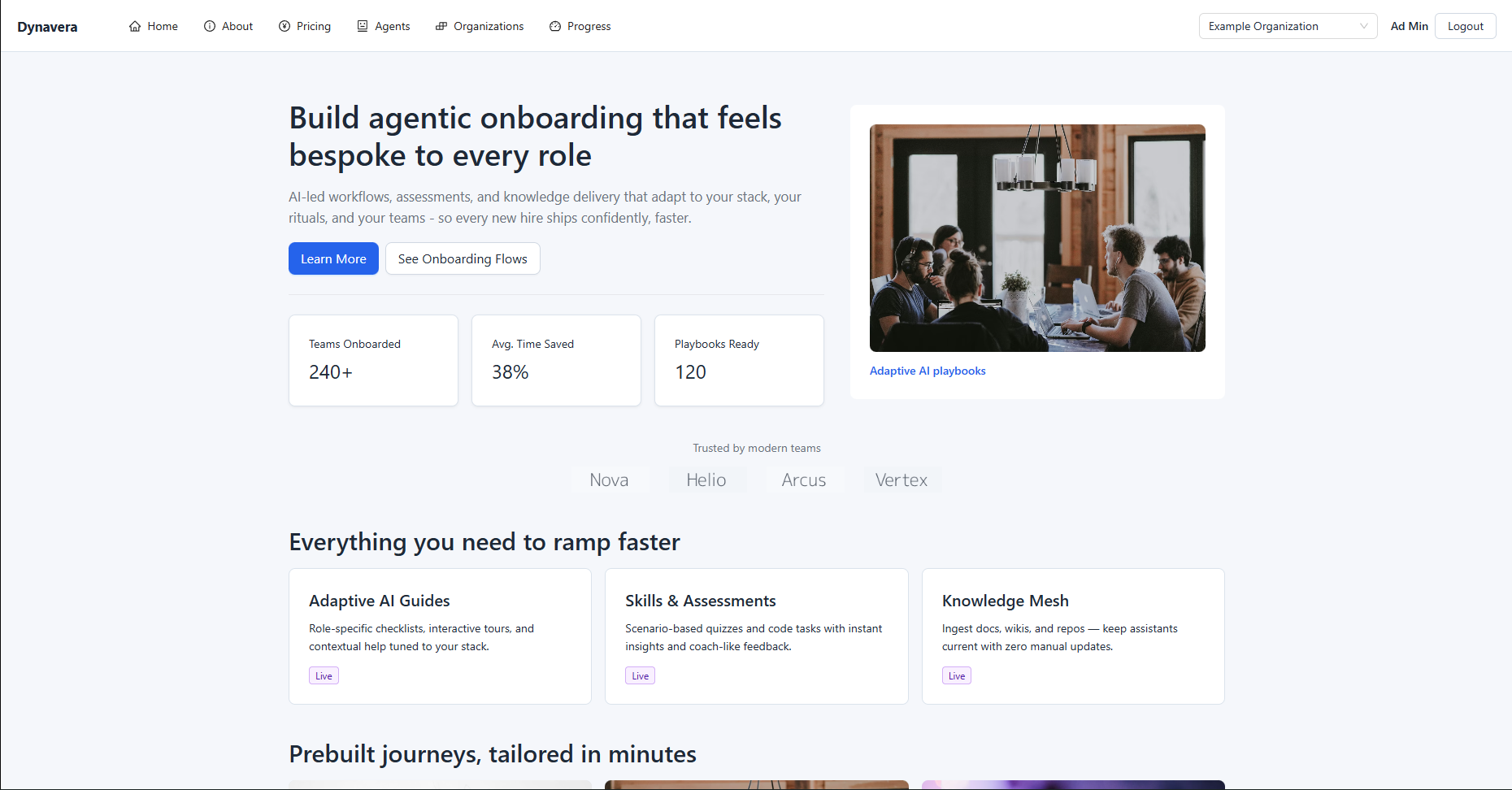
Home Page
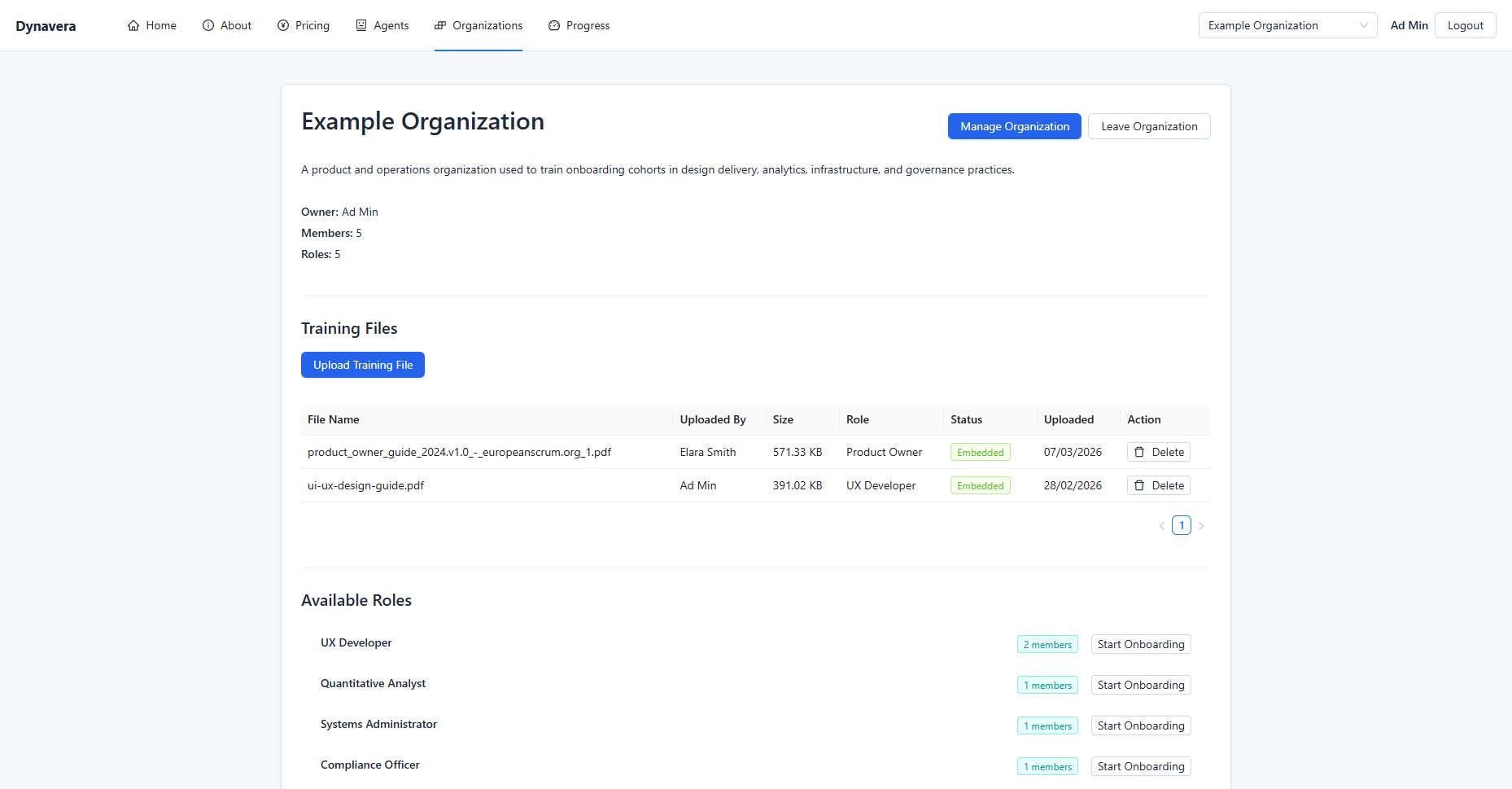
Organization Page
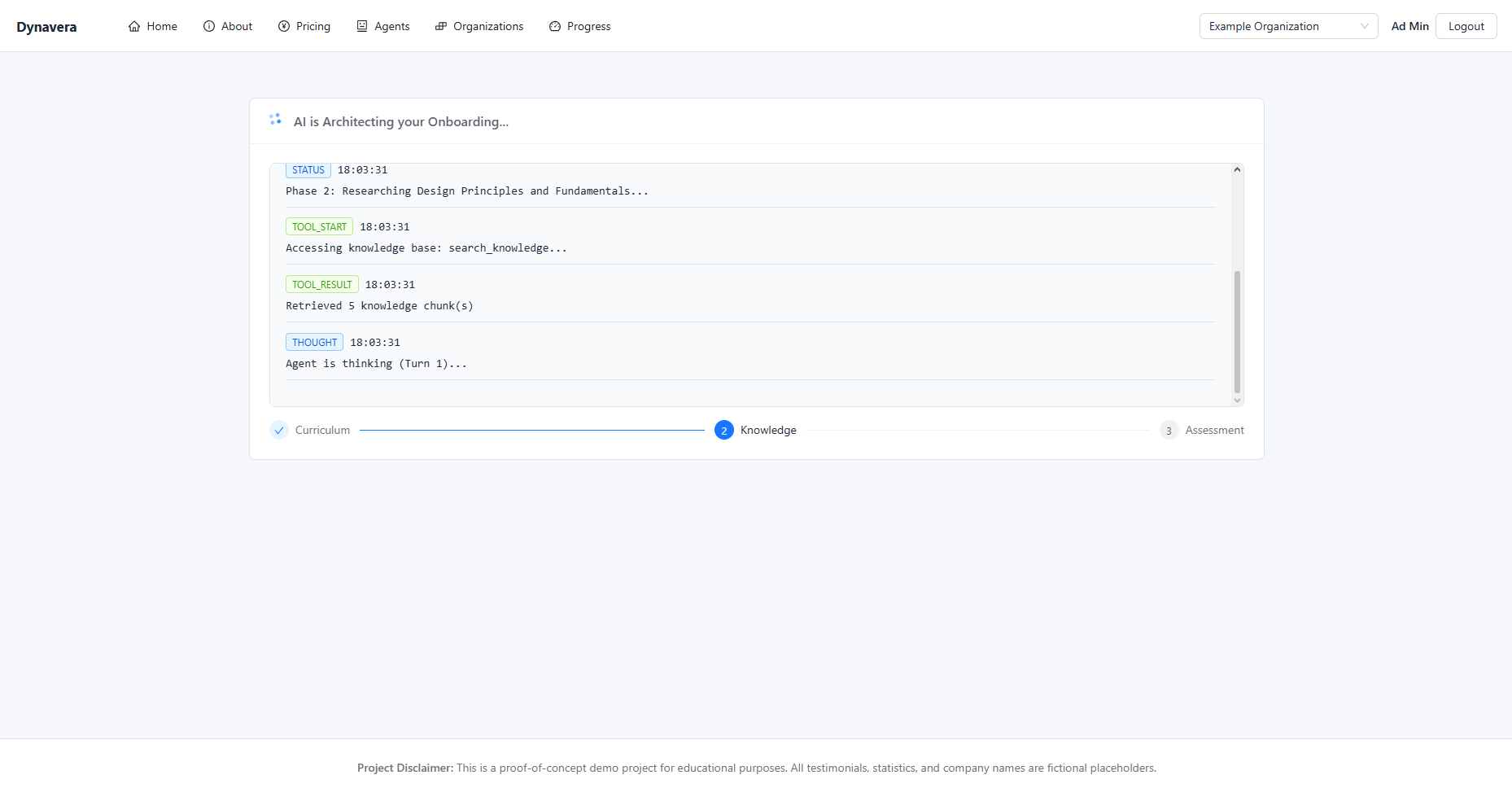
Onboarding Loading / Generation State
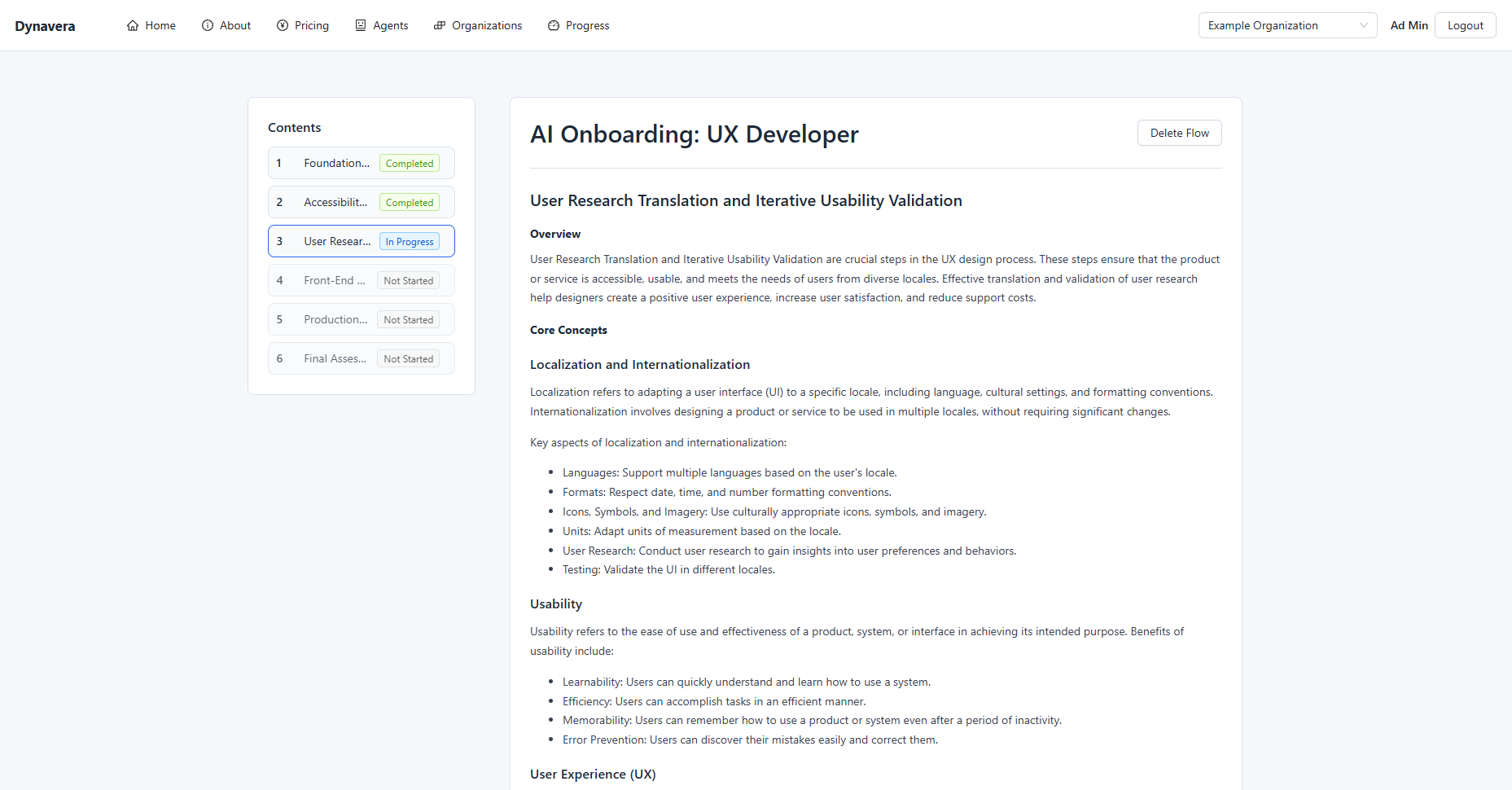
Onboarding Content Flow
System Architecture (High-Level)
At a high level, Dynavera is split into a management side and an inference side. The orchestrator coordinates user interaction, tool calls, and model responses between the two.
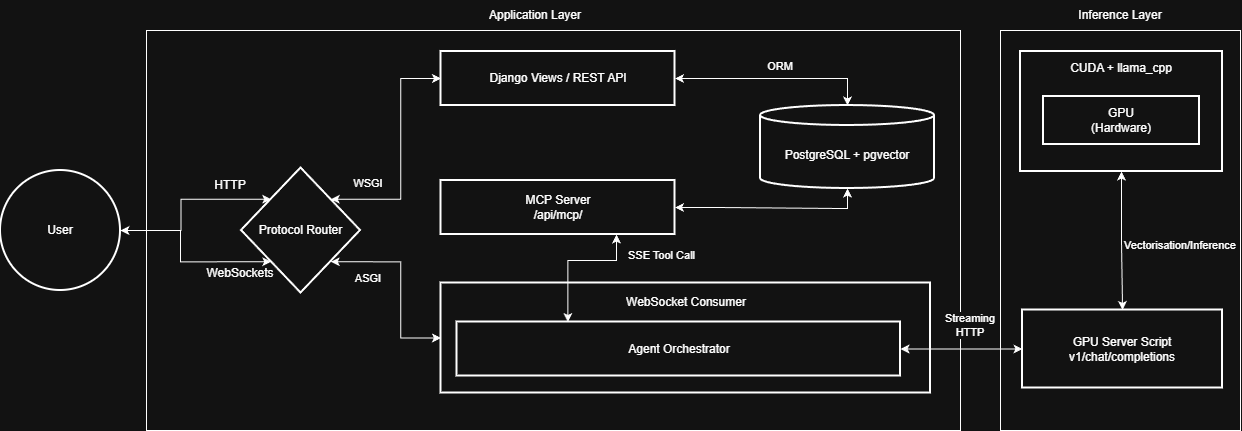
For the fuller architecture narrative (runtime flow and component placement), see:
Project Goals
- Distributed orchestration across VPS and GPU nodes
- Context-aware onboarding with RAG (semantic chunking + vector search)
- Stateful agent workflow over WebSockets
- Automated ingestion from role training documents (PDF/TXT)
Tech Stack
- Backend: Django, Django REST Framework, Django Channels
- Frontend: Vue 3, Vite, Pinia
- Database: PostgreSQL with pgvector
- AI/ML: FastAPI, Sentence Transformers, llama.cpp-compatible serving
- Infra: Docker, Redis, Celery
Repository Guide
Key areas in the repo:
apps/accounts: user model, organization/role ownership, membership flowsapps/knowledge: file ingestion, chunking pipeline, vector document persistenceapps/onboarding: role flows, sessions, websocket orchestration, MCP-style tool routingconfig/: settings, API/ASGI routing, environment wiringcompose/: development and production deployment manifestsgpu_server.py: inference and embedding service
For a more detailed breakdown:
Notable Branches
These remote branches are useful for understanding how the project evolved:
origin/main: stable integration branch used for the current baseline.origin/feature/node-setup: early full-stack setup work introducing the initial frontend/backend server shape.origin/feature/agents: branch focused on agent-related backend changes, including pgvector-oriented database work.origin/feature/mcp-workflow: workflow iteration branch around MCP/testing flow changes.origin/feature/model-rag: branch associated with the model/RAG stream and related frontend scaffolding during that phase.
Run git branch -r to view all remote branches.
However, the main branch will be the primary focus as a lot of the code contained in the feature branches was used for testing different approaches and iterations, which then got consolidated or removed as the project evolved. The code in these branches may not be in a fully working state, and some of the approaches explored there were ultimately not used in the final implementation.
Evaluation Credentials
| Role | Password | |
|---|---|---|
| Admin | admin@example.com | admin |
| Manager | haleisaac@example.com | password |
| User | j.thompson@example.com | password |
Manager registration code: MANAGER2026
Recommended Evaluation Walkthrough
- Open https://fyp.viswamedha.com
- Log in as Manager and open the target organization
- Upload a role-relevant document (PDF recommended)
- Wait for ingestion and embedding completion
- Start role onboarding and trigger generation
- Check if responses are grounded in uploaded material
- Optionally review progress details and logs
If the hosted deployment is unavailable, local setup is documented below.
Local Setup (Cross-Platform)
Prerequisites
- Docker Engine / Docker Desktop
- NVIDIA drivers + NVIDIA Container Toolkit (for GPU inference)
1) Clone
git clone https://git.cs.bham.ac.uk/projects-2025-26/vxn217
cd vxn217
2) Create .env
PowerShell
Copy-Item .env.template .env
CMD
copy .env.template .env
macOS/Linux
cp .env.template .env
Then update .env values for your environment.
3) Start services (development)
docker compose -f compose/dev/docker-compose.yml --env-file .env up -d --build
4) Access endpoints
5) Optional: reset seeded passwords
docker exec -it fyp-django-dev python manage.py reset_passwords
Reset defaults:
- Admin users:
admin - Manager and user accounts:
password
Common Commands
Stop services:
docker compose -f compose/dev/docker-compose.yml --env-file .env down
Tail logs:
docker compose -f compose/dev/docker-compose.yml --env-file .env logs -f
Run migrations:
docker exec -it fyp-django-dev python manage.py migrate